
 Aug 31, 2026


Quick Answer: A B2B invoice is a formal payment request one business sends to another afterdelivering goods or services. It must include an invoice number, payment terms (Net 30/60/90), line items, a due date, and accepted payment methods. Manufacturers, distributors, and wholesalers using Resolve can advance up to 90% of approved invoices within 24 hours, so net terms don't have to mean waiting 60 days to get paid.
What's in This Article
- What a B2B invoice is and how it differs from a B2C invoice
- The complete field checklist for a professional B2B invoice
- What B2B e-invoicing is and how it works
- How net terms invoicing works, and how to get paid in 24 hours instead of 60
- Invoice templates for Net 30 and general payment terms
- FAQ: the most common B2B invoicing questions answered directly
Key Takeaways
- A B2B invoice is both a payment request and a legal record of the transaction between businesses.
- Clear payment terms (Net 30, Net 60, Net 90) set expectations upfront and reduce late payments.
- A complete invoice includes 10 core fields; missing even one (like a PO number) can delay payment from enterprise buyers.
- B2B e-invoicing uses structured digital formats to automate processing and reduce errors.
- Platforms like Resolve advance up to 90% of approved net terms invoices within 24 hours, non-recourse, so you don't wait 30 to 60 days for cash.
- Automating your AR and invoicing can reduce manual AR workload by up to 90%.
What Is a B2B Invoice?
A B2B invoice is a formal billing document one business sends to another after delivering goods or services. Unlike B2C receipts, B2B invoices typically carry extended payment terms (Net 30, Net 60, or Net 90) and serve as both a payment request and a legal record of the transaction.
B2B invoicing is foundational to stable cash flow. The invoicing process is more complex than consumer billing because of factors like varying net terms (Net 30/60/90), bulk orders, and recurring business relationships that require consistent documentation. Getting it right protects revenue and reduces disputes.
B2B vs. B2C Invoice: Key Differences
| Factor | B2B Invoice | B2C Invoice |
|---|---|---|
| Payment timeline | Net 30/60/90 days | Immediate or short-term |
| Average transaction value | Higher | Lower |
| Terms complexity | High (PO numbers, credit lines, tax IDs) | Low |
| Dispute frequency | Higher | Lower |
| Collections process | Formal, multi-step | Simple |
What to Include in a B2B Invoice: Complete Field Checklist
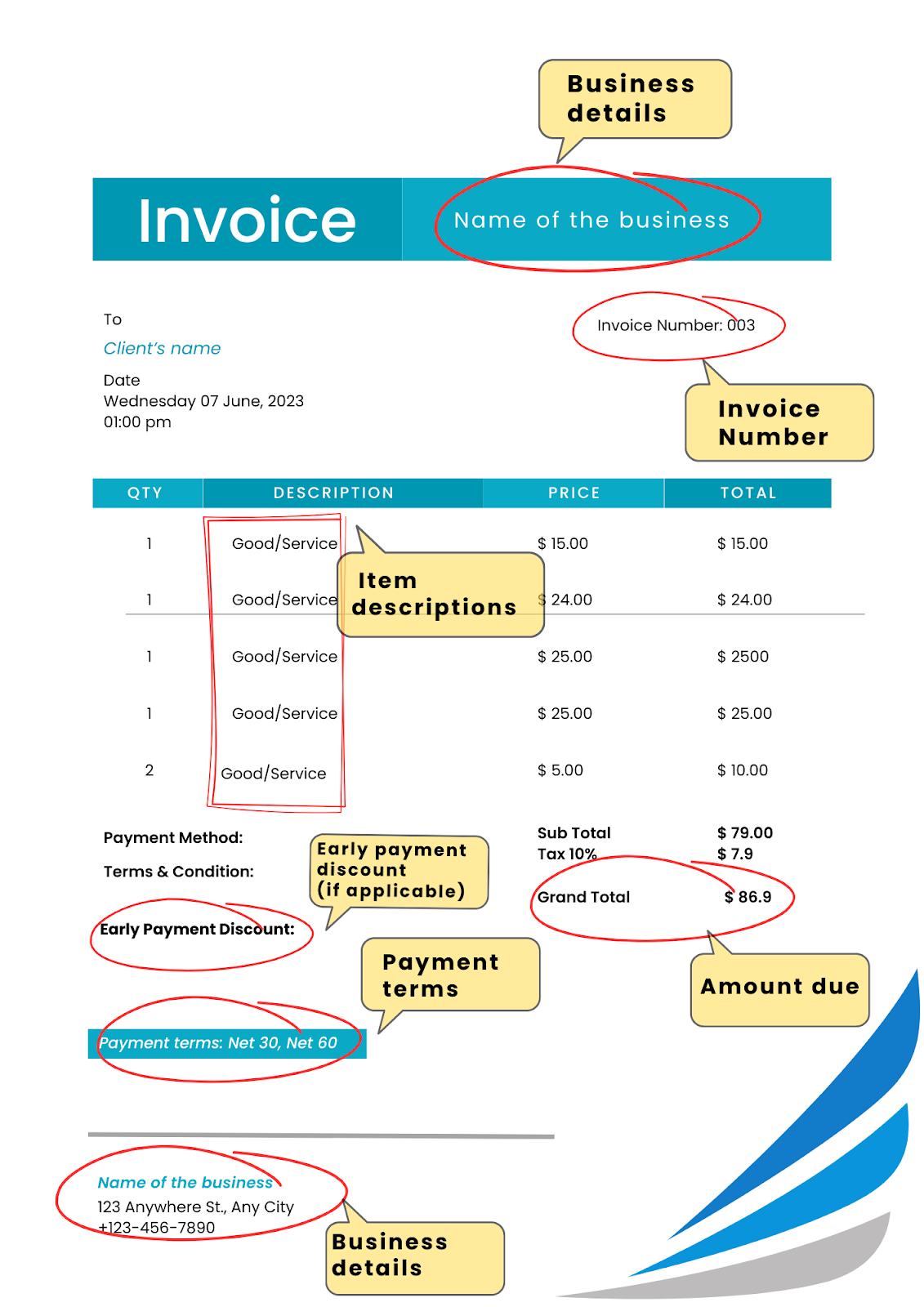
A professional B2B invoice needs more than a total and a due date. Missing a single field is one of the most common reasons enterprise buyers delay or reject payment. Here are the 10 required fields:
- Invoice number: A unique identifier for tracking, audit, and dispute resolution.
- Issue date: The date the invoice was generated.
- Payment due date: Calculated from the agreed net terms (e.g. Net 30 from issue date).
- Seller business details: Legal name, address, and tax ID (EIN or VAT number).
- Buyer business details: Legal name, billing address, and accounts payable contact.
- Line items: Description, quantity, unit price, and line total for each product or service.
- Subtotal, taxes, and total due: An itemized pricing breakdown before and after applicable taxes.
- Payment terms: Net 30/60/90, plus any early payment discount (e.g. 2/10 Net 30 means a 2% discount if paid within 10 days).
- Accepted payment methods: ACH, wire transfer, credit card, or check.
- PO or reference number: Required by most enterprise buyers before they will process payment.
Note: Confirm the purchase order number before sending the invoice. Missing a PO number is one of the most common reasons enterprise buyers delay payment.
Beyond structure, send invoices as close to delivery as possible. The longer you wait to invoice, the longer you wait to get paid. Consider offering early payment discounts as an added incentive for faster settlement.
B2B Payment Options

Several payment methods are commonly used in B2B transactions:
- ACH transfers: Reliable, low-cost electronic transfers between bank accounts. Included in Resolve's platform at no extra fee.
- Wire transfers: Best for large or urgent payments, including cross-border transactions.
- Credit cards: Convenient for smaller transactions; processing fees are typically passed to the buyer.
- Checks: Still common in B2B, particularly among buyers who prefer a paper record.
- Third-party electronic payments: Platforms like PayPal offer real-time tracking and can process in a single business day.
Choose payment methods that align with your buyers' preferences and make sure every invoice clearly lists which options are accepted.
Invoicing Best Practices

An effective B2B invoicing strategy comes down to consistency and clarity:
- Always itemize services or goods provided; never use a lump sum.
- Use a unique invoice number on every document for easy tracking.
- Standardize your invoice format across all customers.
- Specify payment terms upfront, before the work begins, not just on the invoice.
- Verify invoice accuracy before sending to avoid disputes that delay payment.
- Consider automating your AR and invoicing to eliminate manual entry and reduce errors.
- Confirm PO or reference numbers with enterprise buyers before issuing.
What Is B2B E-Invoicing?
B2B e-invoicing is the exchange of invoice data in a structured digital format between business systems, rather than sending a PDF by email. The key distinction: a PDF emailed to a buyer still requires manual data entry on their end. A true e-invoice is machine-readable and processes automatically into the buyer's accounts payable system.
How B2B E-Invoicing Works
- Generate: The seller's system creates an invoice in a structured format (such as XML or UBL).
- Transmit: The invoice is sent through a secure network or API connection directly to the buyer's system.
- Auto-process: The buyer's AP system ingests the data without manual keying.
- Reconcile: Both parties' systems update automatically, reducing errors and audit lag.
E-Invoicing Mandates: What US Businesses Need to Know
As of 2026, there is no federal mandate requiring B2B e-invoicing in the United States for private-sector transactions. This differs from the European Union, where e-invoicing mandates are active or in rollout across multiple member states, and from several Latin American countries where government-issued electronic invoices are required.
For US manufacturers, distributors, and wholesalers, e-invoicing adoption is driven by efficiency and buyer requirements rather than regulation. Many large enterprise buyers (retailers, government contractors, and healthcare systems) require structured invoice formats through EDI or supplier portals. If your buyers are asking for this, check their supplier onboarding documentation for the specific format they accept.
The practical benefit for most mid-market B2B sellers: automating invoice generation and delivery through a platform like Resolve, which integrates with QuickBooks, NetSuite, Shopify, and BigCommerce, achieves most of the efficiency gains of e-invoicing without requiring a full EDI implementation. You can automate B2B invoicing in QuickBooks and sync invoice data in real time.
How Net Terms Invoicing Works, and How to Get Paid in 24 Hours
The 30 to 90 Day Cash Flow Gap
Offering Net 30, Net 60, or Net 90 terms is a competitive advantage for manufacturers, distributors, and wholesalers. Buyers expect it. But the math is brutal for sellers: you deliver goods today, you wait 30 to 90 days for cash. If you have 20 open invoices at any given time, you are effectively financing your buyers' operations out of your own working capital.
This is the core problem net terms invoicing solves when paired with an advance platform.
How Resolve Closes the Gap
Resolve's net terms invoicing platform lets you offer Net 30, Net 60, or Net 90 to approved buyers while receiving up to 90% of the invoice value within 24 hours. The advance is non-recourse, meaning it's yours to keep even if the buyer pays late or defaults on an approved invoice. Resolve takes on the credit risk and handles collections, so your customer relationship stays intact.
Here is how it works in three steps:
- Submit your invoice to Resolve. Approved invoices are funded within 1 business day.
- Receive up to 90% advance within 24 hours. The remaining balance is released when your buyer pays.
- Buyer pays on their agreed Net 30/60/90 terms. Resolve handles follow-up through agentic collections if needed.
This is a fundamentally different model from traditional factoring. Factoring is recourse-based: if your buyer doesn't pay, you owe the factor back. Resolve's advance is non-recourse. That's what makes it smarter than traditional factoring.
Integration With Your Existing Stack
Resolve integrates with QuickBooks Online, Xero, Sage Intacct, Oracle NetSuite, Shopify, BigCommerce, Magento, and WooCommerce. Invoices sync automatically. Payments reconcile in real time. Most teams are live in under a week.
Trenchless Supply, a B2B distributor, reduced their AR workload by 90% and cut credit approval time to under 24 hours after implementing Resolve. That's the operational outcome of combining net terms invoicing with accounts receivable automation.
For a broader comparison of net terms management software, see our full guide.
What Is a Net 30 Business Account?
A net 30 business account is a credit arrangement where the buyer has up to 30 days to pay the invoice in full. Offering net 30 terms extends trust to your customers and can provide a competitive edge, particularly for buyers managing their own cash flow cycles.
When a business extends net 30 terms through Resolve, it can run quiet credit checks on buyers (no notification, no impact on the buyer's credit score) and set appropriate credit limits for each account. The seller gets advance payment of up to 90% per invoice within 24 hours. Net 30 accounts become a tool for financial optimization on both sides of the transaction, not just a payment option.
For guidance on credit management and buyer underwriting, see our complete guide.
Invoice Template With Payment Terms
Having the right invoice template saves time and helps your customers avoid late payments. Below is a sample B2B invoice template with clear payment terms, optimized for businesses offering Net 30 and Net 60 options.
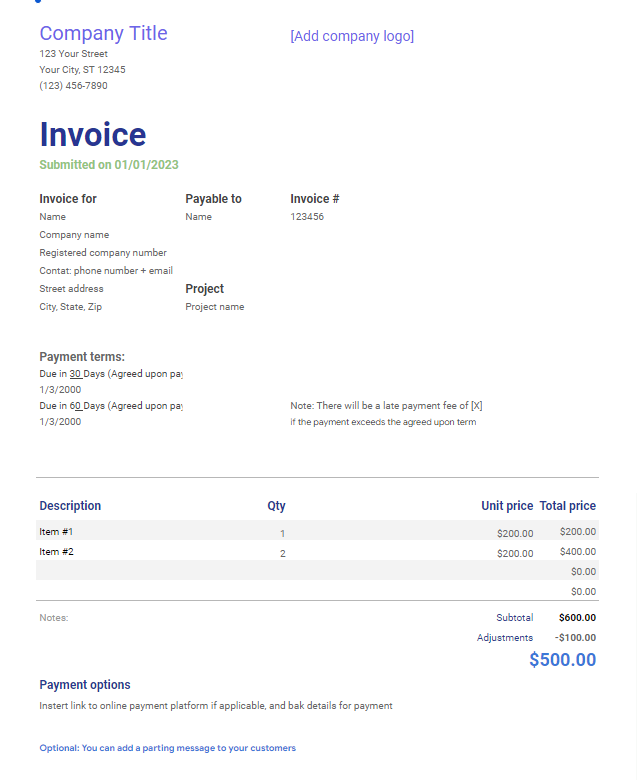
Pair this template with Resolve's B2B payments platform to align your net terms invoicing and payment processes, optimizing both time and cash flow.
Net 30 Payment Terms Template
A tailored invoice template makes your invoicing process more efficient and reinforces payment expectations with your clients. Here is a template optimized for Net 30 payment terms:

This template works best when integrated with Resolve's B2B payments platform, which advances up to 90% on approved net terms invoices within 1 business day. The advance is non-recourse: the amount is yours to keep. Your cash flow stays liquid while your buyers pay on their terms.
B2B Invoice FAQs
What is the difference between a B2B invoice and a B2C invoice?
A B2B invoice is sent from one business to another and typically includes extended payment terms (Net 30/60/90), a PO reference number, and formal business details on both sides. A B2C invoice (or receipt) is issued to an individual consumer, usually requires immediate or near-immediate payment, and involves far less documentation. B2B invoices also carry higher average values and more complex dispute processes.
What payment terms should I include on a B2B invoice?
State the net terms clearly (Net 30, Net 60, or Net 90) along with the exact due date calculated from the invoice issue date. Include any early payment discount, for example, 2/10 Net 30 means a 2% discount if paid within 10 days. Ambiguous or missing terms are a leading cause of late payments in B2B transactions.
How long does a business have to pay a B2B invoice?
Payment timing is governed by the terms agreed between buyer and seller. Net 30 means payment is due within 30 days of the invoice date; Net 60 gives the buyer 60 days; Net 90 gives 90 days. Some industries (construction, government contracting) have statutory payment windows that may override agreed terms. Always confirm terms in writing before delivering goods or services.
What happens if a B2B invoice is not paid on time?
Late payment triggers your collections process. Best practice is a structured sequence: a reminder email at or before the due date, a follow-up call or email within 7 days of the due date, and formal escalation if payment is still outstanding at 30 days past due. Resolve's agentic collections automates this entire sequence across email, SMS, and voice, logging every touchpoint to the invoice record automatically. If you have advanced the invoice through Resolve, collections are handled on your behalf without straining the customer relationship.
How can I get paid faster on B2B invoices without waiting 30 to 60 days?
Resolve advances up to 90% of approved net terms invoices within 24 hours, non-recourse, meaning the advance is yours to keep even if the buyer pays late. Your buyer still pays on their agreed terms; you get cash in the bank the same day. This eliminates the cash flow gap that makes net terms painful for sellers without requiring you to change your payment terms or push buyers to pay early.
Final Thoughts
Clear payment terms, complete invoice fields, and a structured follow-up process are the foundation of healthy B2B cash flow. The practical steps are straightforward: use the right template, send invoices immediately after delivery, confirm PO numbers before issuing, and automate reminders so nothing falls through the cracks.
The bigger opportunity is eliminating the wait entirely. Resolve advances up to 90% of approved net terms invoices within 24 hours, handles credit checks quietly, and manages collections so your team doesn't have to.
See how Resolve's net terms invoicing works and get paid in 24 hours instead of 60. Talk to Sales