
 Apr 23, 2026


B2B commerce used to move at the speed of the sales rep. A buyer called, a credit application got faxed, a check went in the mail two months later, and the relationship held together on trust and repetition. That world still exists in pockets, but it is no longer the one buyers live in most of the time.
Amazon Business is the clearest reason why. Launched in 2015, it now actively serves more than 8 million organizations worldwide, including 97 of the Fortune 100, and drives over $35 billion in annualized gross sales. Whatever a manufacturer, distributor, or wholesaler thinks of that marketplace, its buyers almost certainly use it. And once a buyer has experienced instant credit, transparent pricing, and same-week delivery from one supplier, that experience becomes the floor they judge every other supplier against.
That is the real shift: not where buyers purchase, but what they now consider normal.
The question for modern B2B sellers, then, is not whether to compete with Amazon. It is whether the business is ready for buyers who expect Amazon-era speed, transparency, and convenience from every vendor they work with, whether those buyers arrive through a direct site, a phone call with a rep, a marketplace listing, or a procurement system.
This guide covers what changed, what buyers expect now, and the financial and operational infrastructure modern B2B sellers are putting in place to meet those expectations. It is a readiness playbook, not a reaction plan.
What Amazon Actually Changed
Amazon Business did not win B2B by having a bigger catalog. It won influence by changing buyer psychology. The catalog, the logistics network, and the Fortune 100 adoption are consequences. The behavioral shift is the cause, and it applies to every B2B category, not just office supplies and MRO.
Four expectations, in particular, have migrated out of marketplaces and into the broader market.
Instant credit decisions
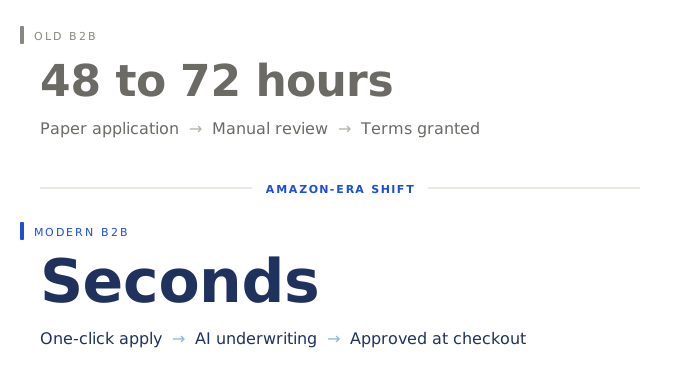
Buyers who once tolerated 48 to 72 hour credit approvals now consider that process broken. They have seen what instant underwriting looks like, and they know it is technically possible. According to a 2025 Gartner survey of 632 B2B buyers, 61% prefer an overall rep-free buying experience, and a follow-up Gartner survey published in early 2026 put that figure at 67% of B2B buyers preferring a rep-free experience. Waiting three days for a credit decision is, increasingly, a reason to walk.
Transparent, flexible terms
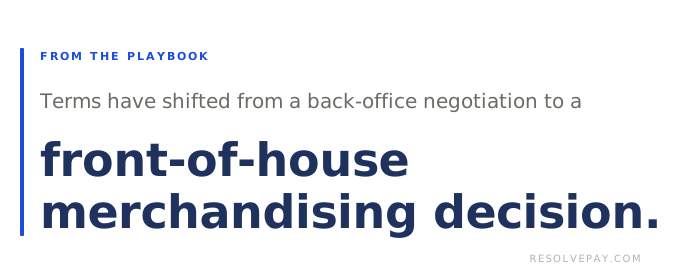
Net 30, net 60, and installment options are expected to be visible at checkout, not surfaced only after a phone call with accounts receivable. Terms have shifted from a back-office negotiation to a front-of-house merchandising decision. When a buyer cannot see what their payment options are on the product page, they assume the answer is "cash up front."
Consumer-grade checkout
No paper forms. No PDF applications emailed back and forth. No three-day gap between wanting to buy and being able to buy. The McKinsey B2B Pulse survey of 3,900+ decision makers found that B2B buyers now use an average of 10 interaction channels in a single buying journey, up from five in 2016. Each of those channels is measured against the fastest one.
Continuity across channels
A buyer who researches on a marketplace, negotiates with a rep, and finalizes through procurement software expects their credit, terms, and account history to follow them the entire way. McKinsey found that 54% of B2B decision makers would abandon a purchase or switch suppliers over a poor omnichannel experience. Fragmentation is not a tolerated inconvenience. It is churn.
These four expectations are not exclusive to buyers who use Amazon Business. They are the new B2B baseline, and Amazon is the reason they spread.
The Three Capabilities Every Modern B2B Seller Needs
Meeting those expectations requires infrastructure, not willpower. Three capabilities matter more than the rest: instant credit decisioning, embedded branded payment experiences, and interoperable infrastructure that works across sales channels.
Instant credit decisioning
The old credit model (paper applications, bureau pulls, manual review, references called one at a time) is dying, and not quietly. It was designed for a world where the buyer was captive to the seller's timeline. That world is gone. Gartner's 2025 survey also found that 73% of B2B buyers actively avoid suppliers who send irrelevant outreach, which is the same impatience expressed on the outreach side of the funnel.
Modern AI underwriting uses financial databases, cash flow signals, and behavioral data to approve buyers in seconds, often with lower default rates than manual review because the models see more data points per decision than a human ever could. Resolve's credit engine, for example, evaluates thousands of buyer data points to produce an instant decision, with approved invoices advanced up to 100% within roughly a day. Resolve reports that sellers using the credit engine see sales cycles compress by roughly 90% and buyer purchasing power roughly double. For sellers, this collapses the sales cycle from days to minutes and pushes credit from a gating function into a growth function.
The practical test is simple. If a buyer discovers a product on a Tuesday afternoon, can they place the order that same afternoon on terms, with no phone call? If the answer is no, the seller has a structural disadvantage that no amount of outbound can fix.
Embedded, branded payment experiences
B2B buyers do not want to be handed off to a third-party checkout mid-purchase, especially for a supplier they are just starting to trust. A checkout that suddenly redirects to a generic payment brand feels like the transaction has left the seller's site, because it has. That break costs conversion and, over time, costs repeat purchase.
White-labeled financing, branded buyer portals, and net terms that appear as a native payment option on the seller's own checkout page outperform unbranded equivalents because they hold the relationship. The buyer's sense is that they are working with the supplier, not with a finance company the supplier happens to use.
This matters operationally, too. Resolve reports that merchants offering embedded net terms at checkout see average order value increase by about 40% and year-over-year sales growth of roughly 20%, figures that sit inside the broader BNPL research range. Independent studies from BCG and PartnerCentric put AOV lifts in the 15% to 40% band and conversion lifts around 39% when pay-later options are integrated into checkout. The branded portal is the user-visible layer. The AOV lift is what pays for it.
Interoperable infrastructure
Modern B2B sellers rarely have a single sales motion. The same account might be served through a direct ecommerce site, a field rep, an inside sales team, an integration into the buyer's procurement system, and a third-party marketplace. When payment and credit infrastructure only works in one of those surfaces, the rest of the business runs on spreadsheets and apologies.
The cost of siloed infrastructure is concrete: data fragmentation, credit decisions that do not travel between surfaces, inconsistent buyer experience, AR teams doing manual reconciliation across four systems. The benefit of interoperable infrastructure is the inverse. One credit profile per buyer. One set of terms. One source of truth for AR.
Resolve's native integrations with BigCommerce, Shopify, NetSuite, QuickBooks, Magento, and WooCommerce, along with an open Partner API, are built around that reality. The broader point is not about any one platform. It is that financial rails should be platform-agnostic, because the seller's sales motion is.
Why Specialization Still Wins
Scale is not the only way to win in B2B, and it is worth saying so directly. Vertical expertise, curated catalogs, and consultative sales are areas where focused sellers routinely outperform generalists, because the buyers in those categories are buying something that general marketplaces are poorly positioned to provide: context.
A buyer sourcing industrial equipment for a specific regulated application is not looking for the lowest price across 10,000 SKUs. They are looking for the supplier who understands the failure modes of their equipment, the compliance requirements of their industry, and the after-sales service they will need in year three. A foodservice buyer sourcing specialty ingredients for a seasonal menu is not buying on convenience. They are buying on the relationship with a supplier who can get them a specific cultivar on short notice.
Forrester research cited in Gartner's 2025 buyer work notes that 48% of first-time B2B buyers enter the process with a preferred vendor already in mind, and that share rises to 47% among C-suite buyers. Preference is built long before the RFP. For specialized sellers, that preference is usually built through domain expertise, not through matching a generalist on selection.
Categories where specialization continues to win include industrial equipment, specialty foodservice, auto and heavy-duty parts, safety and MRO supply, and medical and laboratory distribution, among many others. The common thread is that the buyer's job is complicated enough that getting it wrong has real cost, and a focused supplier is worth paying for.
The point here is not that specialization is a way to compete with Amazon. It is that specialization is about merchant identity, and that identity is a real source of defensibility regardless of where the buyer starts their journey. What Amazon changed is not whether specialization matters, but what the infrastructure around it needs to look like. A specialized seller with a great product and a three-day credit approval is still losing to specialized sellers with great products and three-minute approvals.
Meet Buyers Where They Are
Modern B2B buyers do not follow a single journey, and they have not for years. They research on one surface, negotiate on another, and finalize on a third, and they expect continuity across all of them.
A realistic buyer path in 2026 might look like this: a procurement manager sees a product on a marketplace, confirms spec on the supplier's direct site, pings a rep for a volume quote over email, runs the final order through the company's procurement platform, and pays on net 60. Five surfaces, one decision, one buyer. McKinsey's research puts that kind of journey in context: omnichannel ecommerce has become the leading channel by revenue for B2B organizations that offer it, and 39% of B2B buyers now spend $500,000 or more per order through self-service or remote interactions.
Sellers who can offer consistent credit, terms, and buyer experience across every one of those surfaces win. Sellers who can only offer them through one channel effectively force the buyer to choose which channel to buy through, which is a choice the buyer did not want to make. Valley Tech, for example, saw buyer purchasing power rise by roughly 50% after introducing zero-friction net terms across channels, by removing the cash flow constraints that had been capping their buyers' order sizes.
The operational reality behind this is genuinely difficult. Each channel has its own checkout logic, its own credit workflow, and its own invoice format. Without a common layer of financial infrastructure, a seller ends up running four versions of the same business. With that common layer, they run one business that happens to have four front doors.
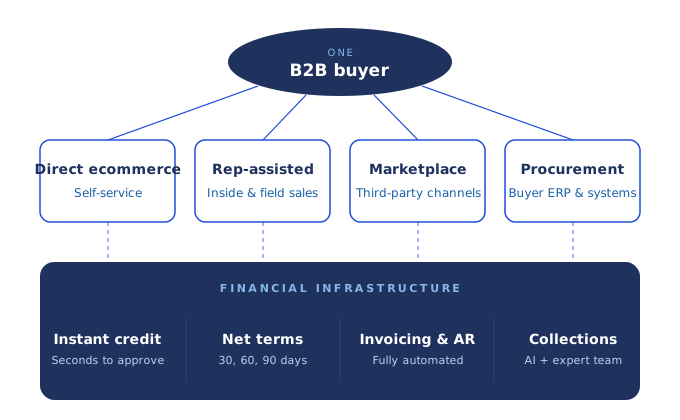
The winning posture is to choose infrastructure partners whose rails work across channels, and to stop treating multi-channel B2B as an exception. It is the default reality of modern commerce, and it is not going back.
Financing as Infrastructure
For most B2B sellers, financing has historically been a product: a checkbox at the end of a sales cycle, handled by a separate team, with its own operational overhead. That framing is getting harder to defend. In a world where 79% of B2B buyers consider flexible payment terms essential to their business's success, financing is no longer a product. It is infrastructure. It sits under the entire buyer experience, the way payments rails sit under consumer commerce.
Treating it as infrastructure means a few specific things are table stakes:
- AI-powered credit decisioning that approves buyers in seconds, not days, with decisioning logic that scales to thousands of accounts without adding headcount.
- Flexible net terms (30, 60, 90) and installment options offered at the point of purchase rather than after a conversation.
- Automated invoicing that fires off the order rather than the AR team's morning queue.
- AI-powered collections that handle routine follow-up and escalate only the exceptions, reportedly saving merchants around 14 hours of AR work per week.
- Cash advance on approved invoices, so the seller gets paid inside 24 hours while the buyer still gets their 30 or 60 days.
- Multi-channel buyer portals that let a single buyer manage their account across ecommerce, rep-assisted, and offline purchases.
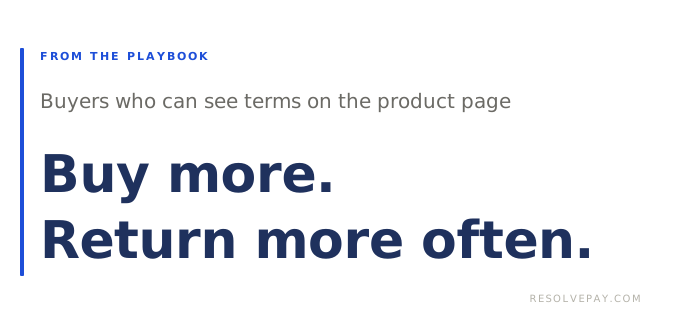
The business impact of treating financing this way is the part that tends to surprise operators. Resolve reports that merchants using the platform typically see order value rise by around 40%, year-over-year sales grow by roughly 20%, and DSO on approved invoices collapse to about a day. The named case studies make the pattern concrete: Nandansons grew financed transaction volume by 75% month over month after consolidating their B2B payments on Resolve; Shields Childcare Supplies won new business by offering Net 90 terms through Resolve rather than turning those buyers away. The mechanism is not mysterious. Buyers who can see terms on the product page buy more and return more often, and sellers who get paid on day one stop running their business from behind their receivables.
This is what "financing as infrastructure" means in practice. It is not a product pitch. It is a category shift that the most effective B2B sellers have already made.
The Future is Interoperable
The B2B sellers winning in five years will be those whose financial infrastructure works everywhere: direct, marketplace, sales-assisted, international, and through whatever new surfaces emerge between now and then. The defining posture is openness, not control.
Three signals suggest this is the direction of travel. First, buyer behavior already demands it: the average 10-channel buying journey is not going to get shorter. Second, the vendor side is consolidating around open APIs and native integrations rather than closed, proprietary stacks, because closed stacks cannot keep up with how many surfaces matter. Third, the most forward-leaning fintech and commerce partnerships (the platforms, the banks, the ERP ecosystems) are explicitly building for interoperability.
Closed, proprietary systems will age out, not dramatically but steadily, the way legacy on-premise ERP aged out against cloud-native alternatives. Open, integrated systems will win, because they are the only ones that can absorb the next channel shift without a rebuild. Resolve is built for that world, and the broader takeaway is that any B2B seller building financial infrastructure in 2026 should be asking the same question of any partner: does this system make us more interoperable, or less?
Ready for the Buyers You Already Have
The buyers most B2B sellers want to keep are already operating in the Amazon era. They use marketplaces. They expect instant credit. They compare checkout experiences, even when they do not frame it that way. The most useful thing any seller can do is meet them there, with infrastructure that works across every surface the buyer uses, and get back to selling the things the seller is actually good at.
That is what modern B2B financial infrastructure is for. See how Resolve's B2B net terms work end to end, run a free business credit check on one of your customers to see the credit engine in action, or estimate the ROI of net terms on your business.
Further reading from Resolve:
- Customer stories: how B2B merchants use Resolve across manufacturing, distribution, and wholesale
- Net Terms for ecommerce: embedded net terms for Shopify, BigCommerce, Magento, and WooCommerce
- Managing existing Net Terms: for sellers already extending credit in-house
- Pricing and the Partner API for platforms embedding net terms natively
Frequently Asked Questions
What is Amazon Business, and how big is it?
Amazon Business is Amazon's B2B marketplace, launched in 2015. As of its announcement in August 2025, Amazon Business actively serves more than 8 million organizations globally, including 97 of the Fortune 100, 66 of the FTSE 100, and 38 of the DAX-40, and drives over $35 billion in annualized gross sales.
How has Amazon Business changed B2B buyer expectations?
It raised the baseline for four things: instant credit decisions, transparent and flexible payment terms visible before checkout, consumer-grade checkout experiences, and continuity across channels. These expectations now apply to every B2B supplier a buyer works with, not only marketplace transactions.
What payment options do modern B2B buyers expect?
Most modern B2B buyers expect net 30, net 60, and net 90 terms, plus installment options, to be visible at the point of purchase rather than negotiated after the fact. A 2024 Balance-cited study found 79% of B2B buyers consider flexible payment terms essential to their business's success.
What is embedded B2B financing?
Embedded B2B financing means credit decisioning, net terms, and payment processing are offered as native options inside the seller's checkout or quote flow, rather than as a separate application handled off-platform. The buyer experience stays within the seller's brand, and the financing partner handles underwriting and AR behind the scenes.
How do instant credit decisions affect B2B sales?
Instant credit decisions shorten sales cycles and reduce cart abandonment. Gartner research shows 61% to 67% of B2B buyers prefer a rep-free buying experience, and buyers routinely abandon purchases when credit approvals take multiple days. Sellers using AI-powered underwriting can approve most qualified buyers in seconds rather than 48 to 72 hours.
What is multi-channel B2B commerce?
Multi-channel B2B commerce means selling through more than one surface: a direct ecommerce site, a sales rep, a marketplace, a procurement system integration, and phone or field sales, often for the same buyer on the same order. McKinsey's 2024 B2B Pulse Survey found B2B buyers now use an average of 10 interaction channels in a single buying journey.
How do net terms affect average order value?
Offering net terms at checkout consistently lifts average order value because buyers can align purchases with their cash flow rather than capping orders at what is in the bank that day. Independent research puts BNPL-driven AOV lifts in the 15% to 40% range across industries, and Resolve reports that merchants typically see AOV rise by roughly 40% and year-over-year sales grow by about 20% after adopting embedded net terms.
What is Resolve Pay, and how does it work?
Resolve is a B2B payments platform trusted by over 15,000 businesses that offers embedded net terms, AI-powered credit decisioning, automated invoicing and AR, agentic collections, and non-recourse advance pay. Sellers offer their buyers net 30, 60, or 90 terms at checkout; Resolve underwrites the buyer in real time, advances up to 100% of approved invoice value within about a day, and handles collections. The seller gets paid up front while the buyer pays on terms.