
 Jun 02, 2026


Recap of the Anchor Group Podcast, hosted by Caleb Schmitz with Resolve's Alec and Mark.
If your B2B sales team has ever spent 1-2 weeks underwriting a new customer for net terms only to watch the order go somewhere else, this episode is one to share with your finance lead. Caleb Schmitz of Anchor Group sat down with Alec and Mark from Resolve to dig into what Resolve actually does, where it fits in a NetSuite-plus-e-commerce stack, and why the merchant being the bank is the part that quietly breaks growth.
.svg)
Key takeaways
- Resolve turns net terms onboarding from a two-to-three week underwriting process into a credit check that runs in about ten seconds.
- The check needs four pieces of information: business name, business address, AP phone number, and AP email. Instant approvals commonly run up to $25,000, and to $50,000 or higher depending on the public data available on the buyer.
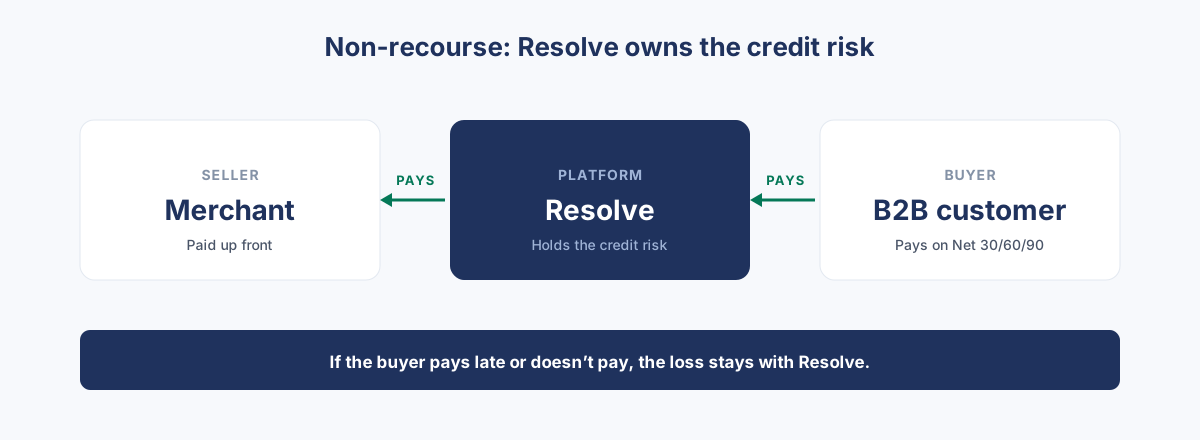
- The financing is non-recourse. Net 30, 60, 90, and installments up to six months are supported. Resolve owns the risk on advanced invoices.
- Resolve is the sister company of Affirm but exclusively B2B. Fee structure is closer to standard credit card processing than to consumer BNPL.
- Advance amounts are flexible. Take 100%, 25%, or zero. Merchants can absorb the fee, split it with the buyer, or pass it through entirely.
Stop being the bank
Mark framed the central pain point bluntly: most merchants who offer terms are also acting as the bank, the underwriter, and the collections team. That stack of roles costs cash flow, costs labor, and costs relationships when collections turn ugly.
"With Resolve, you don't have to be the bank."
— Mark, Head of Partnerships @ Resolve Pay
Resolve sits in that gap as non-recourse financing. The merchant picks the terms structure they want to offer, or lets the buyer pick from Net 30, 60, 90, or installments up to six months. Once an invoice is advanced through Resolve, the risk transfers. If the buyer pays late or doesn't pay, that's Resolve's problem.
For merchants without a dedicated AR team, or with one underwater with payment chasing and collecting, this is where the operational weight comes off. Resolve becomes an extension of the team rather than a separate vendor, handling new accounts, expanding lines for high-value buyers, and taking collections on accounts the merchant doesn't want to chase directly.
Approval in minutes instead of weeks
The clearest moment in the episode was Mark walking through the actual instant credit check flow. With four pieces of information, Resolve runs a credit check and returns a decision in about ten seconds. As Mark put it: "within 10 seconds, we can just instantly approve somebody for a credit line." Many buyers get instant approval up to $25,000, with some businesses approvable to $50,000 and above based on publicly available data.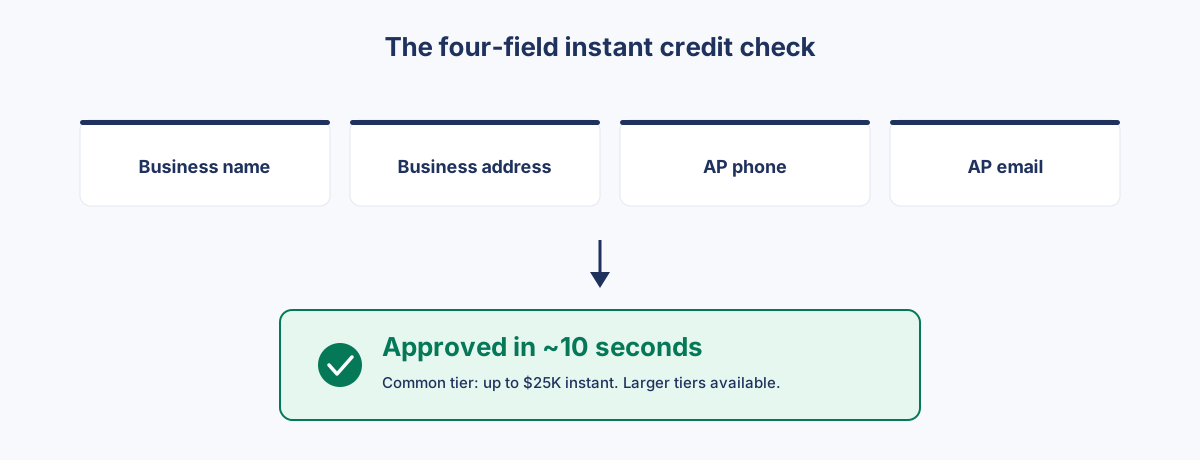
For sales reps, that changes the call entirely. Instead of telling a prospect they'll hear back in two weeks, the rep can run the check on the phone, send a four-field signup link by text, and have the order placed inside the same conversation.
For existing customers with an active credit line, it's faster still. A rep can pull up the customer in Resolve, apply the invoice against the existing line, and close the order on the call.
When instant approval doesn't fire, Resolve falls back to a Plaid bank connection for a deeper look. The point Mark kept returning to: most of the pain in onboarding new B2B customers is the underwriting wait, and most of that wait is solvable.
Where Resolve lands hardest
Across the conversation, Alec and Mark called out a few segments where Resolve produces the largest lift:
- Net new accounts from the internet. Buyers the merchant has never met and can't credibly underwrite on their own.
- Inherently cash-poor segments like contractors. Businesses are always fronting money for their own clients and needing terms to function.
- Expansion of credit lines. Merchants who only float $10K to $15K in-house but have customers who want $75K to $150K to grow into.
- Late payers, the merchant doesn't want to chase. Hand collections to Resolve, preserve the relationship, and free the AR team for higher-value work.
Mark recalled a prior podcast with Jake Voll from SS&SI Dealer Network, a $10M distribution business, who described Resolve as the thing that "just helps him sleep at night." That captured the operational mood. The value isn't only cash flow, it's the headspace that comes from not being the bank.
Sister to Affirm, built for B2B
Alec drew the line between Resolve and consumer BNPL clearly. Resolve is the sister company of Affirm, but where Affirm splits consumer purchases into four installments under consumer risk profiles, Resolve is exclusively B2B. Different rates, different liabilities, different underwriting model. The fee structure ends up closer to rack-rate credit card processing than to consumer split-pay.
Mark drew a similar line against traditional invoice factoring. "We're not like factoring companies," he said. Factoring shops tend to make money on late fees and aggressive collections, which can burn buyer relationships. Resolve's model is built around the merchant keeping the customer.
Built for NetSuite
For merchants running NetSuite as their ERP, the integration question is what tips most evaluations. Caleb framed it directly early in the episode: where does Resolve actually fit in a NetSuite-plus-e-commerce stack?
Alec's answer was the most concrete part of the show. NetSuite-running clients typically do everything out of NetSuite, from sales orders to invoices to customer records to AR. Adding a third-party credit decisioning layer often means weeks of SuiteScript work and a hand-off to a partner consultancy. Resolve handles that work in-house.
"They don't put that burden on the partner."
— Alec, Resolve
In practice, that means orders can flow from any direction. E-commerce checkout, NetSuite sales-order entry, phone or in-store. They end up settled in the same place. The Resolve NetSuite bundle keeps customer records, invoices, advance payouts, and reconciliation synced between Resolve and NetSuite.
Alec also called out the Venn diagram of NetSuite-plus-front-end as where Resolve produces the most lift. Few vendors have invested as deeply in both the checkout experience and the ERP customer-invoice-payment object layer. For agency-led implementations like much of Anchor Group's book, this matters: no separate integration project to budget, no version-control headache when NetSuite or the e-commerce platform updates.
If NetSuite is your source of truth, you can also pull data straight out of it to decide which customer accounts to put on Resolve credit lines first. The integration works both ways.
Where agentic commerce fits
The last stretch of the episode moved to where this is going. Caleb pressed on whether AI agents will reshape B2B procurement. Alec's answer was the most forward-looking part of the show: if a procurement agent places an order on behalf of a business, the merchant has to trust something. A pre-approved Resolve account on the buyer side de-risks that transaction in a way no other primitive currently does. Alec put the merchant's logic in stark terms: "you approved the digital worker to go and order this." The agent is the input method. The trust lives in the underwriting layer.
Mark added the more immediate use case. ERP-connected customer support chatbots that answer invoice and order status questions without surfacing every line of order detail in the storefront.
Watch the episode
The full conversation is on YouTube above. If you're running net terms in-house and feeling the operational weight, this 40-minute session is useful for your finance and sales leaders.
Ready to see how Resolve fits in your stack? Book a demo or learn more at resolvepay.com.